Showing posts with label Non-Fiction. Show all posts

Saturday, March 31, 2012

Eats, Shoots & Leaves


Title: Eats, Shoots & Leaves: Why, Commas Really DO Make a Difference!
Author: Lynne Truss
Illustrator: Bonnie Timmons
Non-Fiction #5


Let’s eat Grandpa. Let’s eat, Grandpa. Proper grammar can save a person’s life!

I absolutely adored this book! Being somewhat of a grammar girl myself, I found this book to be particularly funny but also important and educational. Each page (or set of pages) introduces the same sentence with and without a comma, or set of commas, that are necessary to the overall meaning of the sentence. Children are sure to find themselves laughing along the way as some of the sentences’ meanings are changed entirely simply by adding one comma. The illustrations in the book are also wonderful because they help add to the meaning of the book greatly as well as add to the humor of the book. I found myself laughing at the pictures more than anything throughout reading the story.

My favorite part of the book is the back pages that explain why each sentence needs the comma and why it is wrong without it. Though the terminology may be confusing for younger students, a discussion could be based on the different meanings of the sentences. Additionally, the importance of using commas to make sure what you’re saying is what you mean could/should be emphasized. With older students, each sentence could be given to them without any punctuation and they could try to find out or predict where the comma goes before seeing the correct version of it. I think this book would be great to use in any 3rd grade classroom or older and would be great reference to any student who is struggling with the use of commas. 

How Much Can a Bare Bear Bear


Title: How Much Can a Bare Bear Bear?: What are Homonyms and Homophones?
Author: Brian P. Cleary
Illustrator: Brian Gable
Non-Fiction #4


How Much Can a Bare Bear Bear is an adorable book about homonyms and homophones. Before the student can even read the book, the two words are defined on the first page of the book. This is good because it gives the student an understanding about the terms before delving into the book. Homonyms in the book include can, may, coast, toast, light, trunk, scale, lean, punch, jam, bowl, and roll. The context in which the words were used in was very clear and also quite funny. I loved the illustrations that went along with each page. Not only did they help illuminate meaning but they added to the story and educational value of the text greatly.

Homophones in the book include praise/pray/prey, their/they’re/there, bee/be, flea/flee, burro/burrow, horse/hoarse, ewe/you, fowl/foul, toad/towed, heir/air, whale/wail, male/mail, pair/pare/pear, bust/bused, Barry/bury/berry, band/banned, Mary/marry/merry, sea/see, ball/bawl, moose/mousse, creek/creak, bear/bare, would/wood, Sioux/sue, knew/gnu/new, grease/Greece, etc. Again, the context in which they were used was very clear and funny. The illustrations that were on each page helped the meaning of the text and were cute and funny to look at. I liked them a lot and think kids would like them too.

In the end, I love this book because of its versatility. So many lessons could be done using this book, it could be used for many grades, and the information is so important to know! I can’t tell you how many adults I run into that don’t know how to correctly use certain forms of words. Thus, this text is very educational and very useful. I would suggest having this book in any classroom. Even in the younger grades, only a few pages could be used at a time. Once the children had the meaning down of those homonyms or homophones you could move on to the next few pages and so forth. The educational opportunities this book presents are wonderful! I absolutely loved the clever usage of all of the words and the cute pictures that accompanied them. 

Cleopatra


Title: Cleopatra
Author: Adele Geras
Illustrator: M.P. Robertson
Non-Fiction  #3


The first thing I loved about this book is the fact that it is told through the perspective of Nefret, Cleopatra’s handmaid.  The book is absolutely full of information about Cleopatra and her life in Ancient Egypt. Being someone who has done a research paper or two of this Queen of the Nile, I thought I wouldn’t have learned anything from reading this book. However, I was proven wrong. I learned several small tidbits of information that I had never been exposed to before. I like how the author was able to get in information about other main historical figures from the time including Caesar and Pompey and give the reader some understanding of their significance. Not to mention, the illustrations in this text were absolutely beautiful. They were detailed, colorful, and very interesting to look at. I think kids would love looking at the pictures.

Perhaps my favorite part(s) of the book were at the end. I loved the page that included an illustration of Cleopatra’s family tree and the written description that followed. I feel like the author did a good job of explaining such a complicated royal family and why they intermarried. I also loved the map of Nefret’s world as well as the one of Alexandria. They gave the reader an excellent context for the story that was told. The pages that followed detailed information about the people, the roman army, the Nile River, children and education, pharaohs, pyramids, and religion, gods and goddesses, and the glossary; they were all superb and so full of interesting facts and details . This book alone could stand as the basis of the information gathered for a unit about Ancient Egypt. This is definitely one to add to your non-fiction section in your classroom library. 

You Wouldn't Want to Be a Pirate's Prisoner


Title: You Wouldn’t Want to Be a Pirate’s Prisoner:
Horrible Things You’d Rather Not Know
Author: John Malam
Illustrator: David Antram
Non-Fiction #2


Right off the back I liked how this book put the reader in the role of the main character of the story. Instead of saying “the captain” it says “you” as if you are the captain of the pirate ship throughout the story. I loved this aspect of the book and know kids would be thrilled by it too. The book itself is very interesting and I learned a lot. Being someone who likes and has researched pirates before, this book presented a wealth of new information to me.  I think all children can learn a lot from reading this book and have a good time while doing so. The information is presented in a way that is both thrilling and funny. I particularly enjoyed the “Handy Hints” at the top corner of each page that help the reader as he or she is traveling through the story.

As I previously stated, so much information is in this book. Not only can children learn about the different components of a ship including the supplies and crew but they also get a history lesson because they learn about some of the wars that were going on at the time. I think my favorite page was the one about diseases. Children can read and learn about scurvy, yellow fever, dysentery, and gangrene. The information is truly fascinating. I also liked how in the back of the book there is a glossary. An entire unit of study could be planned around pirates and the glossary could be used to create vocabulary lessons. All in all, I enjoyed the book very much and would recommend it to any classroom teacher looking to include some literature about pirates in their library. 

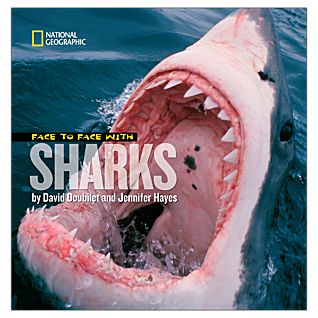
Face to Face with Sharks

Title: National Geographic's Face to Face with Sharks
Author: David Doubilet and Jennifer Hayes
Non-Fiction #1
As a shark lover, I found National Geographic's Face to Face with Sharks to be wildly fascinating. Not only is the book jam packed with information on all different types of shark species but it includes plenty of amazing photos for readers to look at along the way. The book itself is divided up into several sections. The first is entitled "Face to Face" and gives the reader a little bit of background about the authors. The second is entitled "Meet the Shark" and includes general facts about sharks such as the fact that their body is made entirely out of cartilage. The third is entitled "World of Sharks" and describes where sharks live, what water depth you'll find them in, where they migrate, etc. The fourth section is entitled "Conservation", and is perhaps my favorite. In this section the authors detail current conservation efforts for different species of sharks as well as statistical information regarding their depletion. For example, did you know that humans kill more than 100 million sharks every year? 

As I was reading this book, I thought of so many educational connections that could be tied to this text. In fact, entire units of study in literally any elementary classroom could be based off of the information presented in this book. In particular, I liked how at the end of the book there was a section that details how you can help conservation efforts to save sharks. I feel like so many projects could be tied to this information. In addition, there are also sections about what children can do to learn more about sharks, a facts at a glance page, and a glossary that could be used to do a vocabulary unit. I truly feel like the sky is the limit with this particular subject matter. I really loved this book and think it would be a wonderful non-fiction addition to any classroom library.