Showing posts with label Racism. Show all posts

Wednesday, April 18, 2012

Through My Eyes


Title: Through My Eyes
Author: Ruby Bridges
Biography #2


Through My Eyes is the courageous tale of Ruby Bridges, one of the first African-American children to integrate into all white schools during the civil rights movement. Recounted by Ruby herself, the story was literally impossible to put down. I was so intrigued and inspired by her struggles and was in tears nearly the entire time. Reading about what this young girl went through and the horrendous things she had to hear and see every day was heartbreaking. In the same breath, it was so amazing to read about the kindness Ruby and her family received during their difficult time. Letters of encouragement and care packages arrived often; Ruby even received a letter from the former first lady, Eleanor Roosevelt.

Reading this book was especially important to me as a future educator because it really put things in perspective. Though we have come a long way, Ruby’s story isn’t so far in the past that it is no longer relevant. Even with integrated schools, some become highly segregated because of achievement gaps between rich and poor students as well as white and non-white students. I learned so much from reading this book and think children would too. I would use it for students in 4-6 grade and would recommend it to teachers to keep in their classroom library.  

Wednesday, March 21, 2012

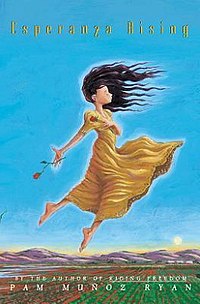
Esperanza Rising

Title: Esperanza Rising
Author: Pam Munoz Ryan
Required Text

Reading Esperanza Rising was like reading a fairytale gone wrong to me. The story begins by detailing the luxurious life of a young girl, Esperanza, who lives on a ranch in Mexico with her wealthy family. Esperanza’s life consists of servants who wait on her hand and foot, fancy dresses and parties, and all of the toys a young girl could ever dream of. However, after a series of unexpected tragedies, all of this is gone. Suddenly, Esperanza and her family must make a drastic change in their life and move to the United States to find work. While in America, Esperanza and her family become farm workers and must live in a Mexican camp with the rest of their race. Not only is this a culture shock for Esperanza, but she isn’t ready for the enormous hardships she now faces. With tragedy waiting around every corner, will Esperanza be able to keep her family together? I enjoyed the uncertainty and suspense this book offered the reader. 

I personally liked this book very much particularly because of the changes the main character, Esperanza, goes through. The reader experiences Esperanza mature very quickly in only a matter of months. To me, it serves as a reminder of what tragedies can do to us and how they can put things in perspective and change us for the better despite the sorrow they bring. I also enjoyed this book because it gave me insight to a portion of what was going on during The Great Depression that I knew little to none about. Reading about Esperanza’s family and the hardships they and other Mexican-Americans endured during this time was truly heartbreaking for me to read on top of the personal dilemmas they face. I would use this book particularly with middle school students because it gives some good insight to what was going on during The Great Depression. It would definitely help illuminate some of the concepts learned in social studies and give the students a better understanding of Mexican-American culture at this time in history. 

Wednesday, March 14, 2012

The Absolute True Diary of a Part-Time Indian


Title: The Absolute True Diary of a Part-Time Indian
Author: Sherman Alexie
Required Text


This story is about a young Indian boy named Arnold or Junior (depending on who you ask). Arnold is your average teenage boy – he loves girls, basketball, and masturbating, but Arnold is also not-so-average. His life on the “rez” and the fact that he has an enormous amount of health problems for a boy his age on top of being poor, nearly-friendless, and overcome with the tragedy of alcoholism in his community all contribute to his not-so-average life. However, Arnold challenges these obstacles when he decides to get off the “rez” and go to an all-white high school in order to better his education. At first, he is treated as an outcast, but by the end of the book the love and acceptance he gains literally brought tears to my eyes. Told from the perspective of someone I found so easy to relate to, I fell absolutely in love with this story. It has been a long time since I have read a book this “real” and enjoyable – it really hit home for me. In fact, I believe it is the best story I have read all semester.

I would recommend this book to anyone and would use it in any classroom 7th grade and up. Though some of the subject matter may be deemed inappropriate for younger audiences, I feel as if what the story has to say and the deeper messages involved override anything that would be questionable for younger students. More importantly, I think the way in which the story is written and the relatability of the characters make it all the more powerful. The tragedy presented in this book is also important as it speaks strongly against alcohol abuse, which is an important topic for all students to learn about and consider particularly at this age. All in all, I loved this book cover to cover and think it is an important read for all students. 

Wednesday, February 29, 2012

Weedflower


Title: Weedflower
Author: Cynthia Kadohata
Required Text


Before I started reading Weedflower I was somewhat unenthusiastic about the book simply because I wasn’t sure what to expect. However, by the end of the first chapter I was hooked and couldn’t put the book down.  I was quickly roped into twelve-year-old Sumiko’s character and was fascinated by the life that she lived with her Japanese family on their flower farm in rural America. Part of the reason I was roped into Sumiko’s character so easily is simply because I related to her and sympathized with what she was going through. When she gets invited to a special birthday party and then gets uninvited because she is Japanese, I just had tears in my eyes. On the one hand, I knew what it was like to be ostracized and bullied but on the other I had no idea what it would feel like to be excluded because of my skin color. It also broke my heart that she had spent so much on the birthday gift when her family was just scraping by. I felt how much she wanted to fit in and it just broke my heart that she wasn’t accepted because of her race.

Then there was Pearl Harbor. The part when she had to burn the only picture she had of her parents because it was “Un-American” and the part when they had to get rid of Baba just broke my heart. Overall, there were so many sad parts in the book that made it so personally touching. I truly view this part of American history in a different light now. As I said with Leon’s Story, parts of America’s past like this seem so far away, so unrealistic and hard to relate to until you see it through the eyes of someone who experienced it. Then the horror becomes so vivid it’s hard to stomach. That aside, I think this text is one that should definitely be used with middle school students. If reading it touched my life, it is sure to touch theirs and give them a better idea of what the Japanese-Americans went through immediately following the attacks of Pearl Harbor.  This was a truly excellent book that I would recommend to just about anyone. 

Tuesday, February 28, 2012

Leon's Story


Title: Leon’s Story
Author: Leon Walter Tillage
Illustrator: Susan L. Roth
Required Reading


In the hundred or so pages contained in Leon’s Story, I learned more about discrimination and the black south than I have ever learned in any history class, and let me tell you, it certainly wasn’t an easy thing to read about. I will admit that in the beginning of the story I had the idea in my head that what I was reading is nothing new to me – I had heard it all before. It is easy to read about racial hate crimes and segregation when the reality of the situation seems so far away. However, by the middle of the book my attitude towards the text changed dramatically. After reading about all of the horrendous things Leon personally witnesses, what happens to him and his family, and the life blacks were forced to live on a day to day basis, I found myself literally sick with hatred for my own people and guilt for what had taken place. I thought to myself, this is a piece of history that hits too close to home, that wasn’t all that long ago, and that still has serious relevance in today’s society. It was a scary realization.

That being said, I think there is a great deal to learn from reading Leon’s story. It is a story that is filled with sorrow, but it is a story that evokes raw emotion that simply can’t be duplicated in a history textbook. The first person accounts in this story are what truly makes the story. The personal connections the reader makes to Leon and his family only make what happens to them more horrifying. I’m unsure of what grade I would use this book in. On the one hand, I feel as if it is much too graphic for young students, even older students. I myself had a difficult time getting through parts of it. On the other hand, the reality of the situation put forth is this story is something that can’t be easily duplicated, thus it seems it would be an important component of a Social Studies unit about slavery. I would feel most comfortable using the text 7th grade and older because of these considerations.